Saturday, March 24, 2012

Camembert Lanquetot

Camembert Lanquetot 

Cheese is a complicated thing. No really, sitting here learning about it i never realized exactly how complicated it really is to make. I mean you first have to process it through the cow...you know milk then add all the fixings to it, then let it fester for a few weeks to make it into the yummy gooey concoction we call cheese....see that's complicated. Complicated and delicious! 


I have found a cheese called Camembert Lanquetot which is a soft, creamy, surface-ripened cow's milk cheese. It was first made in the late 18th century in Normandy in northern France.

Camembert is one of the most famous cheeses in France. Although the cheese dates back only to the 18th century. The origin of the cheese known today as Camembert is more likely to rest with the beginnings of the industrialization of the cheesemaking process at the end of the 19th century. In 1890, an engineer, M. Ridel invented the wooden box which was used to carry the cheese and helped to send it for longer distances, in particular to America where it became very popular. These boxes are still used today. 

Camembert is named after a Norman village where there is a statue of its creator (Marie 
Harel). In 1855 the cheese was presented to Napoleon, introduced as from the village of Camembert. He enjoyed it very much and from that moment Camembert became known everywhere by this name. Specially made in Camembert France ever since the late 1800's.


Brie cheese is a similar soft cheese, also made from cow milk. However, there are differences, as brie originates from the Île de France and camembert from Normandy. Traditionally, brie was always produced in large wheels and thus ripened differently. When sold, Brie typically has been cut from a larger wheel and therefore its side is not covered by the rind. By contrast, camembert is ripened as a small round cheese fully covered by rind changing the ratio between rind and inner part of the cheese (this affects the taste). It thus tends to be sold in thin round wood containers. I personally prefer the ooey gooey Camembert over brie....any day of the week!! :)

-Emily O

Roquefort Cheese


What comes to mind when you think of France? The Louvre? Louis XIV? Cheese, perhaps? France is well known for their distinct cuisine and prides itself on its regional food products. Roquefort cheese is one of the world's best known blue cheeses and is made in the south of France. Though similar cheeses are produced elsewhere, European law dictates that  those cheeses aged in the natural Combalou caves of Roquefort-sur-Soulzon may bear the name Roquefort, as it is a recognised geographical indication, or has a protected designation of origin.


It is a white, tangy and crumbly cheese that is slightly moist and is best recognized by its distinct green veins. The overall flavor begins slightly mild, then alternates between sweet and smoky and, for the grand finale, salty. It has no rind and requires about 4.5 liters of milk to produce a single wheel. 


What would a legend about French cheese be without a love story? Legend has it that  the cheese was discovered when a youth, eating his lunch of bread and ewes' milk cheese, saw a beautiful girl in the distance. He abandoned his meal in a nearby cave and ran after her. He returned many months later and found that mold had transformed his plain cheese into Roquefort. 


The distinctive flavor comes from the soil of local caves. Back in the day, cheese-makers and farmers would leave bread in the caves for six to eight weeks until it was consumed by the mold. Nowadays, the mold is grown in laboratories for better consistency. 


Roquefort is known as one of the smelliest cheeses in the world and the blue mold scares many people away from trying it. For those brave souls willing to give it a go, it is best paired with nuts and figs. Also, in true French fashion, you can always pair it with a crunchy baguette. 


Bon Appetit!
-Jessica Boyd

The Quiche Lorraine


     Originally an open custard pie that was filled with bacon or small pieces of pork fat, the Quiche Lorraine that most people know today has broccoli, cheese, mushrooms, ham, or seafood. However, to true defenders of the quiche Lorraine, there is only one true way to make it.
     As a region situated on the German border, Lorraine kitchens have always had a traditionally large German influence. In fact, the word “quiche” actually comes from the German word “kuchen”, which means cake. Apparently, the only thing that has remained stable in this region is the love for quiche; the Lorraine region has gone from being a part of France, then German, and now French again (it’s a wonder they can keep track). The quiche Lorraine has humble beginnings; it was a rustic farmer’s food that was cooked in a cast iron skillet. There was no puff pastry crust or crimped edges, but a simple bread dough was used to hold the tasty custard.  
        
     As far back as the mid-16th century, the royal court in Nancy (a large city in Lorraine) was eating quiches, but as for the history of the quiche Lorraine that we know, that recipe has only been around since the 1800s. As with most traditional recipes, there is much debate over the true way to cook a quiche Lorraine, but there are some aspects that everyone agrees go in a true quiche. Instead of the modern way of replacing half (or maybe all) the cream with milk, the traditional quiche Lorraine should be “stiff crème fraiche” (which is a soured cream containing 30% butterfat). There is no common liquid cream for their beloved quiche Lorraine. Even the recent addition of shredded cheese has caused an uproar among the defenders of the true quiche Lorraine. I, however, think that the addition of cheese makes a tasty addition, but I digress.
    
     While most quiche Lorraine’s sold now are premade, and then sold to consumers, there are thousands of recipes online. Just make sure that it stays true to the original spirit of the quiche Lorraine! I hope this inspires you to go make your very own quiche Lorraine (or at the very least buy one from your favorite French boulangerie). 

-Samantha Tosh

Thursday, March 22, 2012

How Not to Look Like an American Tourist

        Any guess where this tourist family is from? You are correct: the United States. Now, while it's fairly obvious to those who have been over in Europe for a while who is an American tourist and who is a native, most Americans fresh off the plane to Paris have no idea that they look so blatantly touristy. Maybe it's the bright colors; maybe it's the tennis shoes and jeans; maybe it's the volume of our speaking voices. Any of these, and many more options, could be the cause of this. However, luckily for you, I am here to tell you how to seamlessly blend in with the very fashionable Parisians.
     Parisian fashion can be described in two words: Effortless and Stylish. Hair styles and make-up are minimal, generally highlighting one particular feature. Handbags are usually large and carried haughtily on the elbow, runway style. Shoes are always heels. It's rare to find a woman walking down the street without heels on. You have to admire their dedication, especially on those cobblestone streets. As the home to numerous famous luxury fashion houses, such as Louis Vuitton, Chanel, and Christian Dior, it should seem fairly obvious that the Parisians, and French, take their fashion very seriously. Considered THE fashion capital of the world, this love of all things fashionable started long ago. Even Anne Boleyn was famous for mimicking the French in her dress, though her use of hoods and low cut dresses (scandalous). 
Chanel Fashion Show; Paris Fashion Week 2011
     Paris became known as an international fashion center during the 18th century, when Rose Bertin was named the Minister for Fashion, which carried over to the Napoleonic Era. In the 19th century, an Englishman living in Paris named Charles Worth, the father of "haute couture", was the first to put his name on clothing that he had made. The trend took off, and from then on, if you wanted to make a name for yourself in the fashion industry, you came to Paris. The Parisian fashion status took a hit during the German occupation of Paris in World War II, but they gained their status back at the top after Dior and YSL took over. The most important and influential fashion houses are based here, the biggest fashion shows are here, and grandest fashion magazines are headquartered here. Paris is the place to be when you want to talk fashion. 
       A few tips: well-tailored coats are always an excellent option. Make sure it's a neutral. The Parisians love their neutrals. Leather boots and superrrrrr skinny jeans are a current trend popular with the people. Ballerina flats, tights, and short skirts are popular with the younger generations. Also, no one here really wears sunglasses. Maybe I'm just missing those that do, but from what I've seen, women generally don't wear sunnies. Clothing colors are very neutral; it's not uncommon to see someone completely dressed in black. Knit sweaters are also very stylish, as are scarves. But a warning: scarves have to be tied very creatively. None of that just looping it around the neck nonsense.  
      I hope that this gave you a small insight into what the fashion is like here. While I still know I dress like a tourist in my NorthFace and Sperry's on occasion, I at least know that there are greater opportunities out there. And besides, what better place to come than Paris to decide you need to buy a whole new wardrobe? (:

-Samantha Tosh


Parisian Boulangeries & Patisseries


So this is quite an exciting subject for this blog, i mean who doesn't get excited when talking about food?? I know i do, especially when it's about French food! Now we have been in France for about 8 weeks now, more than enough time to understand the layout of the beautiful city of Paris. We now know how to get around the city and even more importantly we know where to EAT! Now of course there are bigger restaurants that cater  a larger meal but that is not what i will be talking about. I'm talking about the nice, small intimate shops located on almost every corner of every street in Paris. 

I'll start with Boulangeries aka the BREAD place.


Now we all love bread right?? well you think you love it and then you come to Paris and realize that yes, you really do love bread, and you begin to appreciate it more and more as you see that there are people in the world who specialize in bread making...in the making of the perfect bread. It's amazing really...Bakers have been around for centuries, making bread for the people of their villages or for family. It is an art form that has never gone out of style..thank goodness!! Now in Paris you will literally find a bakery or boulangerie on every corner...they take there bread seriously here, as they should. Here are a few types of bread you can find in a boulangerie. Croissant, miche, Baguette....oh baguettes they have stolen my heart...along with others. 

Now onto Patisseries...Now there is a fine line between boulangeries and patisseries, they are closely related to each other because both can sell bread and pastries. BUT when i think of patisseries i think of....fruity tarts like this one...


Or chocolate desserts like this one..


Starting to drool yet???? i do apologize :)
But really this is the type of thing you would see at a patisserie, and so far everything i have ever tried from one has been just amazing! Here is a list of top 10 Patisseries to visit in Paris if you ever get a chance to come out here. The best thing about this is you don't have to just go to one, you can go to them all...I can't tell you how many times we have been to Laduree which is a delicious little place on the Champs Elysees that specializes in their Macarons, but they also have tons of other treats, like tarts and little chocolate concoctions.


But really, if you are in Paris GO HERE...you will not regret it....at all...in fact you will probably want to come find me and give me a hug for making your life better one macaron at a time :) 


So once you understand where to go to get bread and where to go to get sweets, your golden! 
Sometimes if your lucky, there will be a boulangerie and patisserie in the same building...so you can get anything and everything you need....or want...probably want!! :)

I have a close connection to all things bakery inspired because i would like to one day start up my own little bakery/patisserie/boulangerie in Texas...Paris is a big inspiration for me with all of these bakeries, hopefully it will inspire you to either travel over here to see it for yourself or find something like this in your neighborhood. And if there isn't one in your neighborhood i suggest you open one, because America needs more of these....i want to see people walking to work snacking on a baguette ;) Tis just a dream for now but i hope to bring some french culture back with me to Texas when i finally open up my bakery!! :)

Hope you enjoyed my ramblings about some french cuisine!

Au Revoir
-Emily O.

Wednesday, March 21, 2012

Les Invalides


     Wow. Where do I even start? Napoleon's final resting place. A hall dedicated to swords. One of Napoleon's horses that he had preserved. Les Invalides is a highly interesting little place. 
     Originally started by King Louis XIV as a hospital and short-term living place for aging and injured soldiers, construction on Les Invalides was started in 1670 by the architect Liberal Bruant and it was inaugurated in 1679. It holds on of the "greatest triumphs of French Baroque architecture" in its famous golden dome, which was inspired by St. Peter's Basilica in Rome, Italy. Many historical events have taken place here; muskets and cannons were taken by French Revolutionists one morning to use against the Bastille later that day, in 1840, Napoleon was entombed here, and in 1894 the degradation of Alfred Dreyfus was held in the main building. Needless to say, this place is not just a hospital anymore; it is a museum dedicated to the military history of France. 
      The above picture is of Napoleon Bonaparte's sarcophagus, one of the most famous military leaders of all time who changed the face of Europe forever by his military campaigns. I have to say that I wasn't really prepared to see this. You can think that you are ready to see something of this magnitude, but it's kind of hard to comprehend right in the moment. It's so strange to think that someone who had such an impact on the modern world is buried right out in the open, and I was only 20 feet away from him. All around the dome is the burial place of many military leaders of France, including some members of Napoleon's family and many officers that served with him. There is an awesome alter at the front of the chapel that shows the spirit of Louis XIV and his love for gold. Ex:
     Since the whole museum is a huge place, I decided to focus on two main parts: World War I & II and the Napoleon sections. There are SO many well preserved uniforms from all the different countries involved in the conflicts in Les Invalides. It was pretty awesome to see what someone from Austria was wearing in World War I, and they even had an entire section dedicated to American military uniforms from World War I. They make it really interactive by showing visual, moving maps of different battles and campaigns and also having many television sets showing short, informational movies about the wars. They also have quite the collection of artillery, and it was cool to see the progression that technology went through just from World War I to World War II. In WWI, they were using bayonets and small rifles, but in WWII, they were using big guns and tanks. Funny what a difference 30 years make in weapons technology. Speaking of technology, the audio guides here were pretty great; they were iPod touches that you just keyed numbers in to listen to different segments. It was very user friendly and didn't weigh a ton like some of the other ones we've used. 
A high ranking soldier's uniform from World War I
     After we had spent quite a while in the World Wars section, we headed over to the French Revolution and Napoleon section. Least favorite part? It took us a good fifteen minutes to find because they were doing construction on the building, so it made finding the entrance a nightmare. Once we finally found where we were going, it was definitely worth it. Looking at all these rooms dedicated to Napoleon, his successors, and those that helped him achieve his goals was highly enjoyable. It seems to me that Napoleon rivaled Louis XIV in his estimation of himself, and this is not an easy feat. Haha. There are paintings, sculptures, and exhibitions dedicated to the famous little man. Even one of the horses he rode has been stuffed and is on exhibition.. Talk about vain. But it makes for a good museum visit, so I'm okay with it. 
     This is definitely a place I would recommend if you were visiting Paris, and I think that probably almost an entire day would need to be taken to see all of the many war exhibits. And finally, to really give you the true spirit of what Napoleon was, I will leave you with this fine quote: "France has more need of me than I have need of France" -Napoleon Bonaparte.

-Samantha Tosh 


Tuesday, March 20, 2012

Skiing the Alps

     So while I might not be an Olympic skier, it's nice to tell people that my first time skiing was in the Swiss Alps. The Alps are a mountain rage that cross from France to Italy to Switzerland and into Austrian and Slovenia. The Alps cover 65% of Switzerland's surface area and are a huge draw for both tourists and expert skiers. Though-out history, the Alps have played an important part in Switzerland's role in Europe due to their control of the mountains. 
     The art of Alpine skiing (or downhill skiing) originated in the European Alps, which differs from Nordic skiing in that both the toes and the heel are attached to the ski. For most of history, skiing was a way for mountain peoples to travel from one place to another, and modern ski resorts have only been around since the 1800s. After the promotion of winter tourism in Switzerland in the 1860s, skiing soon became a popular winter recreational sport for vacationers. 
     We stayed at Balmer's Hostel in Interlaken, Switzerland, which was only a 30 minute bus ride from the slopes. As one of the top ten hostels in Europe and the oldest privately-owned hostel in Switzerland, I thought it was an excellent place to feel the atmosphere of the town of Interlaken. A little quirky and very fun, Interlaken is the perfect mixture of Swiss professionalism and laid back vacation town. Interlaken's rise to one of the premier resort towns in Europe began during the 1800s after landscape artists noticed the town's great beauty and began selling prints around Europe. After slowing a bit after both World Wars, tourism has constantly been high in this little mountain village.  
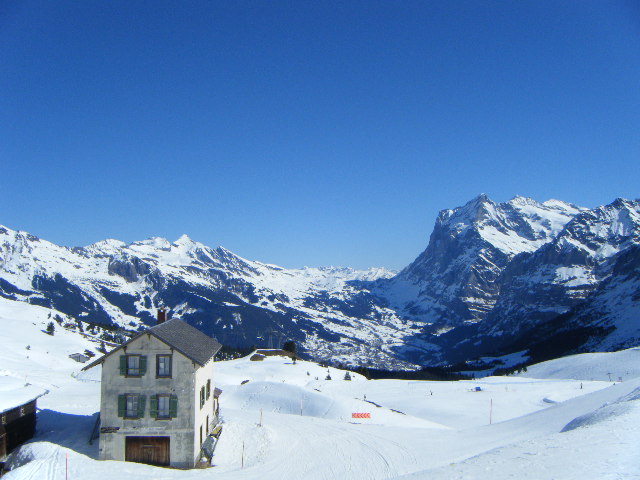
     As embarrassing as it is to admit, I spent about 95% of my time skiing laying on the ground or trying to get my ski back on and only about 5% was actually spent skiing. I'm going to use this as an excuse to get my family to take me skiing soon, so perhaps I will have to come back soon and show Switzerland how much I've improved. I was really jealous impressed with how some of the members of the group picked up skiing almost immediately and were off the bunny slopes to the actual mountain ski paths. I decided to quit after about 3 hours of practicing because they were closing the bunny slopes, and I just didn't feel comfortable yet going down the actual mountain, but three members of our little ski group did without too many major incidents. So I mainly used to rest of afternoon as a picture taking opportunity. Ex:
     The thing that surprised me the most about skiing was that it gets HOT up on that mountain. I know that people had warned me that it was going to be hot, but I was not prepared for it to be 60 degrees up there. Also, I would advise anyone that is going skiing to bring sunglasses. The reflection of the sun on the snow is almost blinding, which created another problem for those of us with sun-sensitive skin: the ski sunburn. I don't know what was more attractive about it; the fact that my entire body, except my face, is winter-y pale, or the fact that my sunglasses gave me a raccoon-like appearance. But it was definitely worth it, sunburn and all (: 
      What I learned from this whole ski experience was that not everyone can pick-up skiing their first time (some of us need days of ski school), little kids are going to be better skiers than you sometimes, just accept it, and to try new, and sometimes uncomfortable, hobbies! Also, I'm being serious; I think my parent's need to take me skiing next winter for more practice. 

-Samantha Tosh